Choosing a footfall monitoring system is not straightforward. There are many technologies on the market, each with different accuracy levels, data richness, cost profiles, privacy implications and practical limitations. This guide compares them.
Quick answer: For most retail, public sector and transport applications requiring ongoing, accurate and privacy-compliant footfall data, AI-based video analytics offers the best balance of accuracy (~98%), data richness and scalability. When using AI-software with existing camera infrastructure, it is also one of the most cost-effective. Infrared beam counters remain cheap for simple single-entrance counting where accuracy above 90% is not critical. Turnstiles are the best choice where physical access control is also required.
At a Glance: Technology Comparison
| Technology | Typical Accuracy | Dwell Time | Heat Maps | Outdoor | Privacy | Relative Cost |
|---|---|---|---|---|---|---|
| Video Analytics (AI Software) | 95-99% | Yes | Yes | Yes | Anonymous | Medium |
| 3D Stereo-Video | 95-99% | Yes | Yes | Yes | Anonymous | High |
| Thermal Sensors | 96-98%* | Limited | No | Partial | Anonymous | Medium |
| Infrared Beam | 85-95% | No | No | Limited | Anonymous | Low |
| Turnstiles | ~99% | No | No | No | Anonymous | High |
| WiFi Probe (Smartphone) | Varies | Yes | Yes | Partial | GDPR risk | Medium |
| Mobile App | Opt-in only | Yes | Yes | Yes | Opt-in | Medium |
| Manual Counting | 70-80% | No | No | Yes | Anonymous | Low (short-term) |
*Thermal sensor accuracy is quoted under optimal ambient temperature conditions. Accuracy decreases when the difference between people’s body heat and the surrounding environment is small – for example, in very hot weather or rooms with high ambient temperature.
The Technologies in Depth
1. Video People Counting via existing cameras & AI software
Here, AI-trained computer visions software connects to cameras and process the video feed in real-time. No facial recognition occurs: the counts are completely anonymous. Some companies, like Retail Sensing, train the AI software in the customer’s specific situation for 98-99% accuracy.
The processing may be on-site (edge computing) or in the cloud with results shown in data dashboards.
Video analytics is the only technology that can simultaneously deliver footfall counts, conversion rate (when integrated with point-of-sale data), dwell time, occupancy, queuing times, heat maps, staff counts, gender and age differentiation from a single installation.
Strengths
- Highest accuracy among non-turnstile technologies
- Works across wide, multi-lane entrances
- Delivers dwell time, occupancy and heat map data
- Integrates with POS systems and third-party platforms
- Remote verification of counts is possible
- GDPR-compliant — no personal data collected
- System performance can be audited and tuned remotely
- Suitable for both indoor and outdoor deployment
Limitations
- Higher initial installation cost than beam counters
- Requires camera positioning at suitable height and angle
Best suited to: Retail chains, shopping centres, transport hubs, libraries, museums, public buildings, outdoor spaces — anywhere that ongoing, accurate and verifiable footfall data is required.
2. 3-D Stereo-Video
Uses two lenses to create a 3D image, which is then analysed to count people.
Strengths
- Has many of the above advantages, but can’t use existing CCTV or IP cameras
Limitations
- Dedicated stereo cameras must be installed, adding greatly to costs.
3. Smartphone Counting – Wi-Fi Probe
There are several ways to count people using mobile signals. One is to collect Wi-Fi probe request signals from peoples’ smartphones.
However, since iOS 14 (2020) and Android 10+ (2019), devices randomise their MAC addresses (the unique identifier of every device on a network identifies every device on a network) making repeated identification of the same device impossible and undermining both count accuracy and tracking capabilities. Plus, the capture of MAC addresses even temporarily is likely to constitute processing of personal data under UK and EU GDPR, requiring a lawful basis, transparent notice and careful handling. Many legal opinions classify passive WiFi probe capture as unlawful without explicit consent, and organisations have been give hefty fines for doing so.
Strengths
- Can cover large open areas
- No physical installation needed.
- Can estimate dwell times.
- Can track people and generate heat maps of popular areas.

Limitations
- Serious privacy concerns – the ethical and data protection considerations of knowing exactly how often a person returns to a location and where they went. Data collection and processing to track and understand shoppers’ behaviour likely qualifies as personal data and will come under data protection regulations with concerns about compliance with GDPR (General Data Protection Regulation).
- MAC address randomisation has severely reduced reliability
- Only counts those carrying a smart phone with Wi-Fi switched on.
- As the battery of a phone gets lower, it does not send out the wi-fi probes as far or as often, making it less likely to be picked up.
- Counters can also pick up signals from people that are outside the counting zone
- The complexity of the environment significantly impacts accuracy. Open spaces generally yield higher accuracy than cluttered spaces with obstacles that can interfere with WiFi signals.
- Counting accuracy tends to decrease as the number of people increases.
- Cannot verify count accuracy
Best suited to: Limited use cases where only rough footfall patterns are needed and legal advice confirms compliance. Not recommended as a primary counting method.
4. App Counting on Mobile Phones
Opt-in mobile apps use geofencing or Bluetooth beacons to detect when a registered app user enters a store or venue. Because users have explicitly consented, the privacy situation is clearer than WiFi probe capture.
The fundamental limitation is sample size. App penetration rates among a store’s visitors are typically low – supermarkets achieve between between 10 and 27% (CMA 2024). This makes it unsuitable as a primary counting method but such loyalty apps are potentially valuable to provide context about the behaviour of the most engaged customers
Strengths
- Records returning customers.
- Counts inside and outside a store or venue.
- Tracks people to generate heat maps of popular areas.
- As it is opt-in, privacy concerns are reduced.
- Wide entrances and outdoor counting covered.
Limitations
- Data is only collected from those who have installed the app.
- Sample bias – app users are not representative of all visitors
Best suited to: Loyalty programme operators wanting to understand the behaviour of their most engaged customers, not as a standalone footfall counting solution.
6. Thermal Sensors
Positioned above an entrance, thermal sensors identify people by measuring their body heat. They produce accurate entry and exit counts and do not capture any visual image, which some operators prefer.
The headline accuracy figures of 96-98% assume a meaningful temperature differential between the person’s body heat and the surrounding environment. In practice, accuracy can degrade significantly in hot weather (above around 28-30 oC or in industrial/kitchen environments where background heat is high. Low ceiling heights can also reduce performance.
Advantages
- High accuracy under optimal temperature conditions
- Privacy – people are not identified .
- Can be networked across multiple entrances
Drawbacks
- Accuracy can be affected by the ambient temperature within the counting area being above or below a certain value. Low ceilings can also reduce the accuracy.
- Have difficulty measuring the dwell time of people.
- Needs a camera or other method to verify counts.
- In crowded situations, it can be challenging for thermal sensors to distinguish between individuals due to overlapping heat signatures.
Best suited to: Temperature-controlled indoor retail environments without overhead cameras.
7. Infra-Red Beam Systems
A sensor sends a beam to a reflector on the opposite side of the doorway. When someone passes through, the beam breaks and a person is counted. These were popular twenty years ago – now higher accuracy and more information is generally needed for most applications.
Accuracy limitations become pronounced in busy periods when two people walk through simultaneously (double counting risk), in wide entrances and when direct sunlight falls on the sensor which can blind the system. Claimed accuracy of 95% is achievable in narrow, low-traffic doorways; real-world accuracy in busy retail is frequently 85-90%.
Advantages
- Privacy – people are not identified.
- Low cost.
- Easy to install.
- Can communicate with server in real-time.
Drawbacks
- Accuracy tends to decrease with wide or busy entrances.
- Vulnerable to direct sunlight interference.
- Don’t measure dwell time or provide heat map data.
- Needs a camera or other method to verify counts.
Best suited to: Simple, low-traffic single-entrance monitoring where budget is the primary constraint and data richness is not required.
8. Turnstile
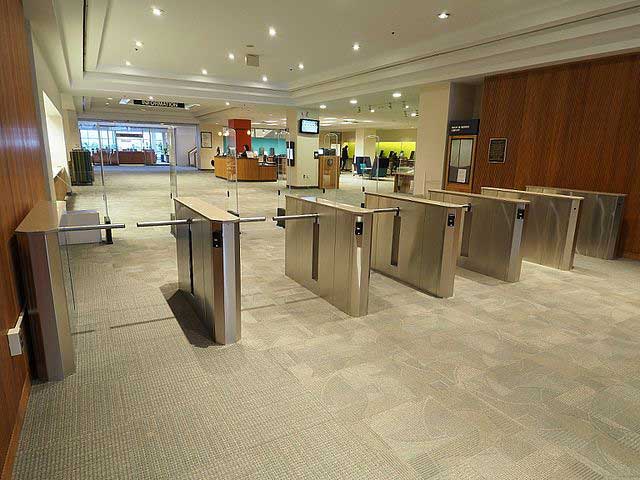
Drop Arm Optical Turnstiles are beam counters which raise a mechanical arm to let people through.
Advantages
- Extremely accurate.
- Good where security is needed.
Drawbacks
- Not suitable for shops and areas where easy access is needed.
- Dwell times and heat maps not available.
Best suited to: Stadiums, transport hubs, gyms, museums and secure facilities where access control is required as well as counting.
9. Manual Counts

Hand-held tally counters are the least sophisticated of solutions. A person stands clicking the tally counter whenever anyone passes through the entrance. This may be acceptable for a one-off people counting excercise, but is obviously unsuited to continuous monitoring. Tally counters were once used in nightclubs and bars to monitor occupancy, but have now been replaced by automatic counting systems.
Advantages
- Cheap if done on a small-scale for a short time.
Drawbacks
- Accuracy varies depending on number of people entering and the person doing the counting. Singh et al found 73-79%
- Verification of counts not possible unless another method is also used.
- Labour-intensive.
- Can’t be automatically integrated with POS system
Best suited to: One-time surveys, system calibration audits or locations where no infrastructure exists and a rough estimate is sufficient.
Questions to ask People Counting System Suppliers
- How is accuracy measured and under what conditions? Ask for a site trial.
- What happens to data accuracy during peak busy periods? Systems that are accurate at low traffic often degrade at peak.
- Is count data verifiable? Can you inspect a sample of counted events against CCTV footage?
- What does the total cost of ownership look like over three years, including hardware, installation, any software licences and support?
- What integrations are available? Can data go directly into your platform or dashboard?
- Does the system comply with GDPR? What personal data, if any, is collected and retained?
Decide what information you want to collect now and in the future
Understand exactly what your business actually needs in the short- and long-term before choosing a system. Obviously entries and exits, but what else?
Dwell Time
How long people spend in a zone or across the whole site. Only available from video analytics, WiFi probe (with the limitations noted above) and mobile apps. Dwell time is a key indicator of engagement and is used to assess the effectiveness of displays, layouts and merchandising.
Heat Maps
Visualisations of which areas receive the most and least traffic. Available from video analytics. Used for optimising layout, deciding where to place products and allocating staff.
Queue Lengths and Waiting Times
Monitoring how many people are waiting at a checkout, service desk or entrance. Available from video analytics. Used for staff scheduling and improving the customer experience.
Conversion Rate
When footfall data is integrated with point-of-sale transaction counts, the conversion rate (percentage of visitors who make a purchase) is automatically calculated. This is only available where an integration between the people counting system and the POS or ticketing system exists – typically video analytics platforms.
Which people counting technology to choose?
We’ve covered a range of ways to count people. If you want to know more about using existing cameras as part of the solution, get in touch. We’re always happy to help.
References
GDPR personal data – what information does this cover? Accessed 7 January 2025
Review of loyalty pricing in the groceries sector, Competition and Markets Authority, 27 November 2024
Singh, S et al (2025). Unveiling Library Footprints: Synergizing RFID and Patron Traffic Counters (PTC) for Data-Driven Space Optimization at ChandigarhUniversity Library, Mehak Book Publishing & Marketing Services, Delhi, pp. 121-129



Thanks for your enquiry, an engineer will be in touch.