
Choosing an automatic passenger counting (APC) system depends on five factors: accuracy, sensing technology, installation location, privacy requirements and integration with your fleet management systems. AI video analytics is increasingly replacing infrared and pressure sensors because it offers higher accuracy, richer data, and lower installation costs when existing cameras are available.
Comparing Automatic Passenger Counting (APC) Technologies
| Technology | Typical Accuracy | Performance in Heavy Crowds | Hardware & Maintenance Impact | Privacy Compliance (GDPR) |
|---|---|---|---|---|
| AI Video Analytics |
95% – 98%+ Verified in real-world conditions |
High Differentiates overlapping passengers and luggage |
Low Uses standard CCTV overhead; no physical recalibration needed from vehicle jolting |
100% Compliant Edge processing converts video to numerical counts locally without storing facial data |
| Infrared Time-of-Flight (ToF) |
90% – 95% Lab conditions |
Moderate Struggles to separate closely packed passengers |
Medium Requires dedicated optical hardware; prone to recalibration needs due to vehicle vibration |
Compliant Generates 3D depth maps rather than identifiable visual imagery |
| Wi-Fi / Cellular Probe Tracking |
60% – 80% Sample-based estimation only |
Low Cannot distinguish exact boarding vs. alighting doors |
Low Simple receiver unit required on board |
High Risk / Restricted MAC address randomized by modern iOS/Android devices; banned in many jurisdictions |
Methods of Passenger Counting
- Video recognition
AI software analyses CCTV and detects people boarding and alighting. The system provides counts in real time to remote data dashboards, and shows where and when people got on and off. - Infrared systems
Infrared Time-of-Flight sensors emit short pulses of infrared light and then measure the time it takes for the light to reflect off objects in their field of view, such as people, and return to the sensor. The sensor builds up a 3D image of its surroundings by measuring the distances to multiple points. On-board processing then filters out static objects while tracking moving objects like people. - Mobile Phone Wi-Fi
Wi-Fi-based systems detect devices within a certain radius using probe request signals. However, use of Wi-Fi tracking from mobile phones is in some places subject to strict conditions, and in many cases prohibited.

Passenger Counting: Factors to Consider
1. Real-World Accuracy Rates
Accuracy is obviously one of the most important characteristics of an automatic passenger counting (APC) system. Indeed, some regions have legislation stating that a specific accuracy must be reached to be purchased using public funding. Most companies offer an accuracy of at least 95%.
In crowded boarding situations AI video analytics tracks individuals separately, improving accuracy during peak loading. Independent research has found video-based APC performs particularly well in real-world deployments, though installation conditions remain important.
Retail Sensing video recognition systems have been tested at 98% accurate. Accuracy is easily checked, in the real-word rather than in a laboratory, by simply watching the video.
2. Operating Conditions
When using physical devices to count passengers on buses, problems arising due to jolting lead to the need for regular recalibration. AI systems bypasses these difficulties
Infrared-based solutions are reliable in some environments, but may have difficulty counting passengers accurately in crowded conditions. Video imaging performs well in crowded vehicles. Wired solutions offer robustness against interference, but may require additional resources for installation and maintenance.

Our APC system uses AI to analyse footage from CCTV cameras. These need to be positioned over the entries and exits of the vehicle.
3. Communications & System Integration
Crucial for device integration. Many interfaces are on offer, for example RS-485, Ethernet, WLAN and Wi-Fi.
Our APC system offers a choice of communication including MQTT for integration into smart cities and the Internet-of-Things. Consider for where the passenger counting information is destined.
4. Robustness
For physical devices, the IP (Ingress Protection) code shows how well a device can withstand, for example, dust or water. Our passenger counting uses our AI software to communicate with cameras, making a very robust system without the drawbacks encountered by physical people counters.
5. Privacy Protection
Make sure people are not identified, either by facial recognition or wi-fi probe signals.
Retail Sensing systems are fully GDPR compliant and collect no personal data.
6. Extras
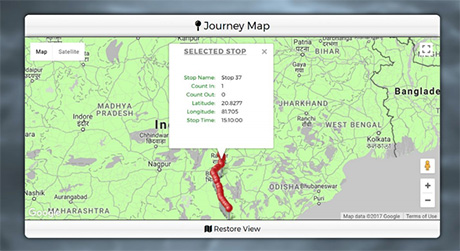
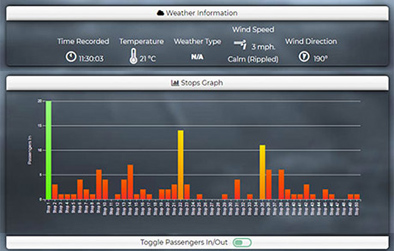
Can the system be expanded if requirements grow? Do you want GPS referenced counts, to log weather conditions, to integrate with smart city systems?
References
Pronello et al. 2024. “Benchmarking the Functional, Technical, and Business Characteristics of Automated Passenger Counting Products” Smart Cities 7, no. 1: 302-324. https://doi.org/10.3390/smartcities7010013
McCarthy et al. 2025. “Video-based automatic people counting for public transport: On-bus versus off-bus deployment” Computers in Industry 164 https://doi.org/10.1016/j.compind.2024.104195
Automated Passenger Counting, Retail Sensing.
The best people counting systems: a complete comparison, Retail Sensing.