Why counting footfall isn’t enough
High traffic looks great on paper. But what if those customers are just browsing quickly and leaving? Or worse, what if they’re spending a long time in the shop then leaving empty-handed because they can’t find what they need?
Without a way to monitor service levels, you’re guessing. Yet most retailers measure footfall… and stop there.
I recently spoke with a retailer who had strong footfall numbers but inconsistent sales performance. The team believed they were “busy,” so service must be fine.
But when we looked deeper, the data told a different story.
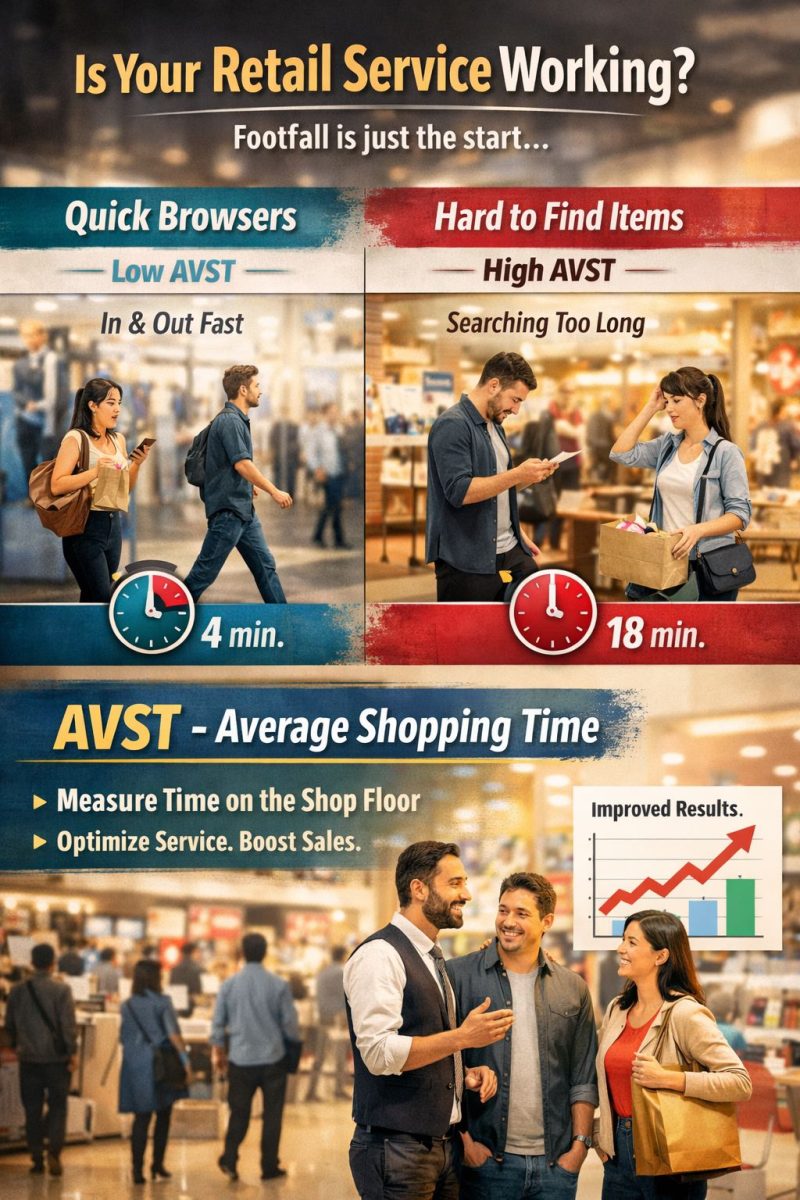
Using AVST (Average Shopping Time), we measured the number of minutes each customer spent in the shop.
The insight was powerful:
- In some stores customers were in and out quickly indicating browsers, not buyers
- In others time spent was unusually high, highlighting layout friction and difficulty finding products
Neither issue was visible through footfall alone.
Improve engagement for higher conversion
The biggest challenge in retail isn’t traffic; it’s service.
With the Average Shopping Time benchmark in place, the retailer adjusted staffing during peak periods and refined the store layout – giving people more of what they came into the store for in the first place.
The result? Improved engagement, smoother journeys and stronger conversion.
Average Shopping Time is the key
At Retail Sensing, we provide AVST as a clear, measurable service benchmark. And when you can measure it in minutes, you can manage it with confidence.
Every retail sector is different, from convenience to fashion to large-format stores.
Context matters.
If you’d like to understand what your Average Shopping Time is really telling you, get in touch.